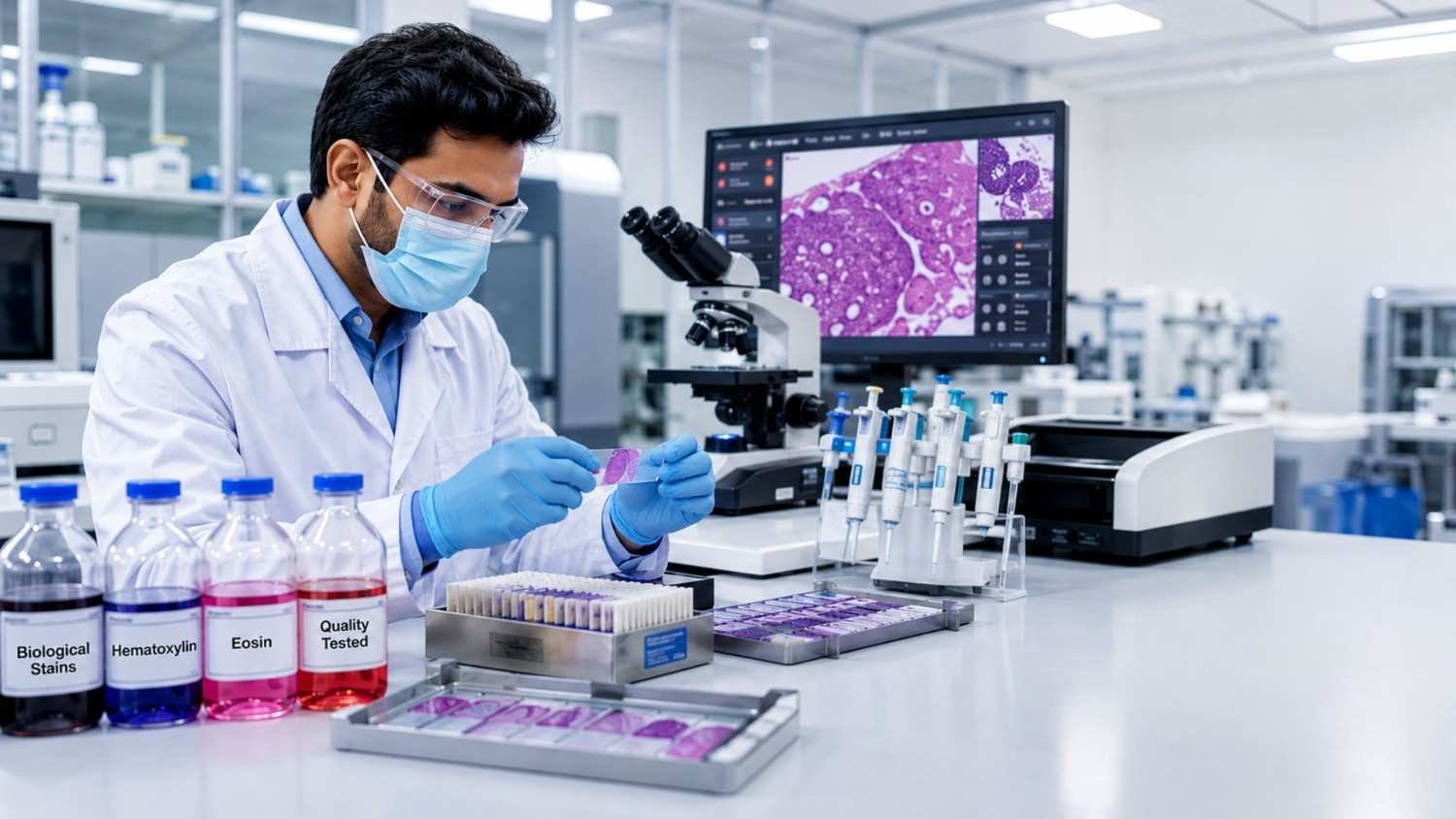
A pathologist reviewing a blood smear under a conventional microscope can mentally adjust for subtle staining variation, and decades of training build an intuitive tolerance for the natural range of acceptable colour and contrast. An AI algorithm analysing a digitised whole-slide image has no such intuition. It interprets pixel-level colour and intensity values exactly as captured, and it has been trained on a dataset of images stained within a defined, consistent range. When the stain quality of a new sample falls outside that range, the algorithm’s confidence and accuracy can degrade in ways that are not always obvious to the laboratory running the test.
This is the quiet but consequential reality of digital pathology’s rapid expansion: as diagnosis shifts from the microscope eyepiece to the digitised, AI-interpreted whole-slide image, the biological stains, Giemsa, Wright’s, Leishman’s, and their Romanowsky-family relatives, have become a more critical variable in diagnostic accuracy than at any point in its 130-year history. For pathologists, laboratory managers, diagnostic centres, and research institutions building or scaling digital pathology workflows, the choice of stain supplier is no longer a routine procurement decision. It is a diagnostic accuracy decision.
How Digital Pathology and AI-Assisted Diagnostics Are Transforming Healthcare?
Digital pathology, the digitisation of glass slides into high-resolution scanned images for viewing, analysis, and storage, has moved from a niche research tool to a mainstream clinical workflow over the past decade. Whole-slide imaging systems now scan stained blood smears, tissue sections, and cytology preparations at resolutions sufficient to support remote diagnosis, longitudinal case comparison, and increasingly, AI-assisted interpretation.
AI algorithms trained for tasks such as automated white blood cell differential counting, malaria parasite detection in Giemsa-stained thick and thin smears, and morphological classification of leukaemic cells are now deployed in clinical and research laboratories globally. These systems offer substantial workflow efficiency gains: faster turnaround, reduced inter-observer variability, and the ability to flag abnormal cases for expedited pathologist review. But every one of these benefits depends on a foundational assumption that is easy to overlook, that the input image accurately and consistently represents the underlying biology, which in turn depends entirely on stain quality and consistency.
Inconsistent vs Certified Stain Supply: The Practical Difference
| Factor | Inconsistent / Uncertified Stain Supply | Certifiable, ISO-Manufactured Stain Supply |
| Colour reproducibility | Varies lot to lot; visible shade drift | Controlled within a defined tolerance, batch to batch |
| AI model performance | Risk of domain shift, reduced model confidence | Stable input distribution supports model accuracy |
| Documentation | Minimal or no CoA; no traceability | Full CoA, batch traceability, reference benchmarking |
| Workflow impact | Repeat staining, manual review overhead | Predictable workflow, minimal rework |
| Regulatory readiness | Limited audit trail for accreditation review | Supports CAP, NABL, and ISO 15189 documentation needs |
Biological Stain Standardisation and Batch Reproducibility
Romanowsky-family stains, Giemsa, Wright’s, and Leishman’s, among them, are chemically complex formulations involving polychromed methylene blue (a mixture of demethylated azure compounds) combined with eosin in carefully controlled ratios. Achieving consistent staining performance requires precise control over dye synthesis and oxidation (polychroming) conditions, accurate weighing and blending of the azure-eosin ratio for each batch, consistent dye purity and absence of contaminating metallic salts, and standardised methanol or solvent quality for stain reconstitution.
Because these stains are inherently sensitive formulations, heat and light exposure can oxidise the dye components and produce undesirable precipitates such as methylene violet. Manufacturing process control and quality testing at every batch are essential to reproducibility. A manufacturer operating under a certified quality management system builds these controls into a documented, auditable process rather than relying on informal production practices that vary with the individual operator or production run.
At GSP Chem, our biological stain portfolio, including Giemsa Stain, Leishman’s Stain, and Wright’s Stain, is manufactured under our ISO 9001:2015-certified quality management system, with batch-specific testing and Certificate of Analysis documentation provided for every shipment. We maintain a dedicated 1,600 sq ft research and development division focused on colour-changing chemistry, supporting both our stain quality programme and the development of innovative diagnostic-relevant formulations.
Why Certified Stain Manufacturers Are the Preferred Choice for Pathology Laboratories?
Pathology laboratories operating under accreditation frameworks, CAP (College of American Pathologists), ISO 15189, or NABL (National Accreditation Board for Testing and Calibration Laboratories) in India, are required to demonstrate that their reagents, including biological stains, are sourced from qualified suppliers with documented quality systems. An ISO 9001:2015 certified manufacturer with a scope explicitly covering biological stain production provides the auditable supplier documentation that accreditation bodies expect to see during laboratory inspections.
Beyond regulatory readiness, certified manufacturers reduce the operational risk inherent in scaling digital pathology and AI-assisted diagnostic programmes. As laboratories invest in whole-slide scanners, image management infrastructure, and AI diagnostic models, often substantial capital investments, protecting that investment requires a reagent supply chain capable of delivering the staining consistency those systems depend on. Sourcing stains from an uncertified, inconsistent supplier introduces risk precisely at the point where laboratories have the most to lose from unreliable input data.
Conclusion: Stain Quality Is Now an AI Infrastructure Decision
Digital pathology and AI-assisted diagnostics have quietly elevated biological stain quality from a routine laboratory consumable consideration to a foundational element of diagnostic AI infrastructure. The accuracy of a malaria parasite detection algorithm, the confidence of an automated white blood cell differential, and the reliability of cross-site diagnostic comparison all trace back, in part, to the consistency of the Giemsa, Wright’s, or Leishman’s stain used to prepare the original slide.
For pathologists, laboratory managers, diagnostic centres, and research institutions building or scaling digital pathology capability, the practical implication is clear: stain supplier qualification deserves the same rigour applied to scanner selection and AI model validation. GSP Chem, as an ISO 9001:2015 certified manufacturer and Government of India-recognised One Star Export House, supplies biological stains to laboratories and research institutions globally with the batch documentation and consistency that digital pathology workflows require.
To request a Certificate of Analysis or a pre-shipment sample of our Giemsa, Wright’s, or Leishman’s stain, contact our team at sales@gspchem.com.