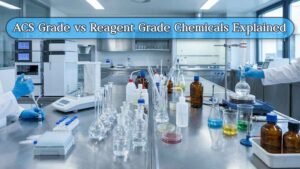
When purchasing laboratory chemicals, selecting the correct grade is essential for ensuring accuracy, compliance, and reliability. Two of the most commonly encountered classifications are ACS Grade and Reagent Grade chemicals. While they may appear similar at first glance, there are important distinctions in standards, certification, and application suitability.
Understanding these differences helps laboratories, pharmaceutical companies, research institutions, and quality control teams make informed procurement decisions.
Understanding Chemical Grades
Chemical grades indicate the purity level and intended use of a substance. Different industries and applications require varying degrees of purity, documentation, and testing.
For example:
- Research laboratories may require high analytical precision.
- Pharmaceutical manufacturing demands strict compliance and traceability.
- Industrial processes may tolerate broader impurity limits.
ACS Grade and Reagent Grade chemicals both fall into the high-purity category, but their specifications are not identical.
What Are ACS Grade Chemicals?
ACS Grade chemicals meet standards set by the American Chemical Society (ACS). The ACS establishes detailed purity criteria published in its official reagent standards. These specifications define maximum allowable levels for impurities, assay ranges, and test methods.
To qualify as an ACS Grade, a chemical must:
- Meet or exceed ACS purity specifications
- Be tested using approved analytical methods
- Include documentation confirming compliance
ACS standards are widely recognized internationally and are often required in regulated laboratory environments.
Key Characteristics of ACS Grade Chemicals
1. Strict Purity Specifications
ACS Grade chemicals are tested against defined impurity limits. These limits are clearly documented and publicly available through ACS publications.
2. Standardized Testing Methods
The testing procedures used to verify purity follow validated methodologies.
3. Global Recognition
Many laboratories worldwide reference ACS specifications as a benchmark for analytical work.
Because of these characteristics, ACS Grade chemicals are frequently used in analytical chemistry, pharmaceutical testing, and regulatory environments where reproducibility is critical.
What Are Reagent Grade Chemicals?
Reagent-Grade chemicals are also high-purity substances intended for laboratory use. However, the term “Reagent Grade” does not necessarily mean the chemical meets ACS specifications unless explicitly stated.
In many cases, Reagent Grade indicates that:
- The chemical is suitable for laboratory applications
- It has high purity
- It meets internal or manufacturer-defined standards
The exact purity criteria may vary depending on the supplier unless it is specifically labeled as “ACS Reagent Grade.”
The Core Difference Between ACS Grade and Reagent Grade
The primary difference lies in standardization and certification.
ACS Grade
- Must meet ACS-published purity standards
- Has defined impurity limits
- Follows standardized testing procedures
- Offers higher regulatory acceptance
Reagent Grade
- High purity, but may not follow ACS specifications
- Purity standards may vary by manufacturer
- Suitable for general laboratory use
In simple terms, all ACS Grade chemicals are reagent grade, but not all reagent grade chemicals meet ACS standards.
When Should You Choose ACS Grade Chemicals?
ACS Grade chemicals are typically preferred in:
- Pharmaceutical analysis
- Regulatory testing laboratories
- Academic research requiring publication-quality data
- Quality control testing
- Validation and method development
If a laboratory operates under regulatory frameworks or must meet strict documentation requirements, ACS Grade chemicals provide an added layer of confidence.
When Is Reagent Grade Sufficient?
Reagent-Grade chemicals are often appropriate for:
- Routine laboratory experiments
- Educational institutions
- Non-regulated industrial testing
- Preliminary research
In cases where ultra-strict impurity control is not critical, Reagent Grade chemicals can provide cost-effective solutions without compromising basic laboratory needs.
Documentation and Compliance Considerations
ACS Grade chemicals typically come with detailed Certificates of Analysis (CoA) that reference ACS specifications directly. This is particularly important in environments subject to audits.
Reagent-Grade chemicals also include CoAs, but the specifications listed may be based on internal standards rather than ACS benchmarks.
For laboratories operating in regulated markets such as the US, Europe, or Brazil, verifying documentation is as important as verifying purity.
Cost Differences
Because ACS Grade chemicals undergo strict compliance with established standards, they may be priced higher than general Reagent Grade chemicals.
However, cost should not be the only decision factor. Using a lower-grade chemical in a regulated environment may lead to inconsistent results or compliance risks, which can be more expensive in the long run.
Common Misconceptions
Misconception 1: Reagent Grade and ACS Grade Are Always Identical
Not necessarily. Unless the label explicitly states ACS compliance, reagent grade may not meet ACS specifications.
Misconception 2: Higher Grade Always Means Better Results
The appropriate grade depends on the application. Over-specifying chemicals for routine use can increase costs without measurable benefit.
Misconception 3: Industrial Grade Is Similar
Industrial-Grade chemicals are generally not suitable for analytical laboratory use due to higher impurity levels and a lack of detailed documentation.
How to Verify Chemical Grade Before Purchasing
Before placing an order, laboratories should:
- Review the product label carefully
- Check the Certificate of Analysis
- Confirm whether ACS specifications are referenced
- Evaluate intended application requirements
- Consult supplier documentation for impurity limits
Clear communication with suppliers helps ensure the selected grade aligns with the laboratory’s technical and regulatory needs.
Final Thoughts
The difference between ACS Grade and Reagent Grade chemicals lies primarily in the level of standardization and compliance with published purity specifications. ACS Grade chemicals meet strict standards set by the American Chemical Society, making them ideal for regulated and analytical environments. Reagent-Grade chemicals offer high purity suitable for general laboratory applications, but may not always align with ACS criteria.
Selecting the correct chemical grade is essential for ensuring accuracy, compliance, and cost-efficiency. Laboratories should evaluate their application requirements carefully before deciding which grade best meets their needs.
Understanding these distinctions empowers procurement teams, researchers, and quality managers to make informed, confident purchasing decisions.
Whether your project requires the rigorous standards of ACS Grade or the reliable performance of Reagent Grade, GSP Chem provides the high-purity solutions your laboratory can depend on.