Food waste is a major challenge for manufacturers, distributors and retailers, particularly when handling perishable products such as meat, seafood and dairy. Food can deteriorate during storage and transportation, even when it is within its stated shelf life. Traditional expiry and best-before labels provide estimated dates, but they cannot show the actual freshness condition of a product after changes in storage conditions.
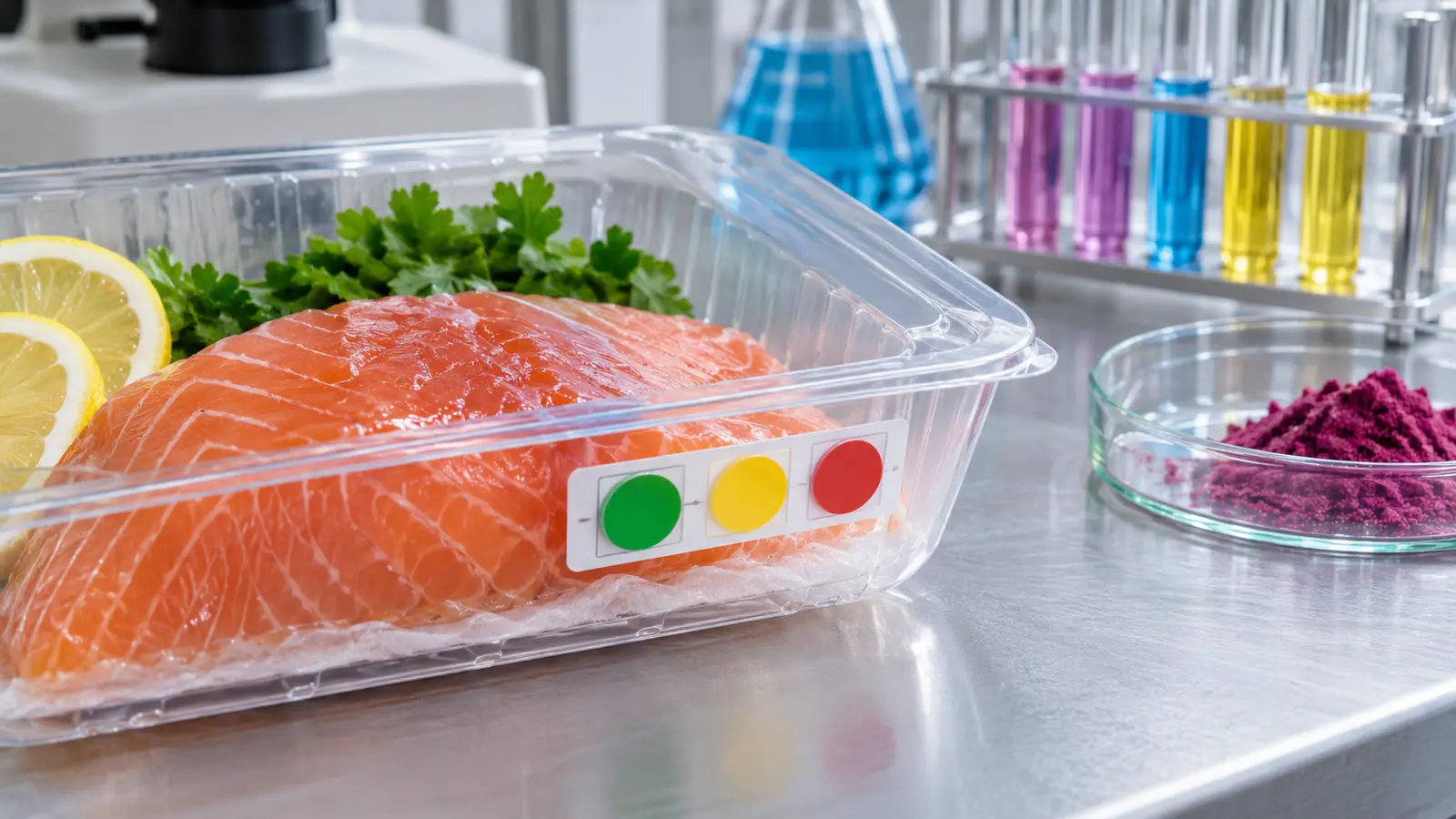
Colorimetric freshness indicators offer a more responsive approach. These indicators change colour when they detect specific chemical changes associated with food deterioration. Integrated into food packaging, they provide visible freshness information that can help businesses monitor product quality, improve inventory decisions, and reduce unnecessary disposal.
What Are Colorimetric Freshness Indicators?
Colorimetric freshness indicators are sensing materials that produce visible colour changes in response to particular chemical substances or environmental conditions. They are commonly incorporated into packaging labels, films or sensor patches.
Unlike conventional labels, which display fixed information, these indicators respond to changes occurring around the packaged food.
Several materials are used to develop them:
- Anthocyanins – Natural pigments found in berries, red cabbage and other plants. They change colour depending on pH conditions.
- Curcumin – A turmeric-derived pigment that responds to changes in its chemical environment.
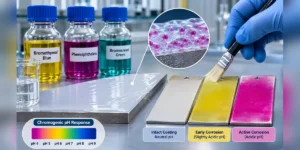
- pH-sensitive dyes – Compounds such as bromocresol green and bromothymol blue that produce different colours at different pH levels.
The choice of material depends on the food product and the chemical changes the indicator needs to detect.
How Do Colour-Changing Indicators Detect Food Spoilage?
Food deterioration involves microbial activity, enzymatic reactions and chemical breakdown. These processes can produce volatile compounds that accumulate inside food packaging.
In fish and meat, spoilage-related compounds may include ammonia, trimethylamine and other volatile basic nitrogen compounds. Their accumulation can change the pH of the package environment.
A suitable pH-sensitive indicator responds to these changes by altering its colour.
The process generally follows four stages:
- Food deterioration – Microbial and enzymatic activity produces chemical changes in the food.
- Compound release – Spoilage-related gases accumulate in the packaging headspace.
- Chemical reaction – The indicator responds to the target compounds or associated pH changes.
- Visible indication – The sensing material changes colour, providing information about the product’s freshness condition.
The colour response is compared with a validated reference scale to help interpret the product’s condition.
How Do These Indicators Reduce Supply Chain Waste?
One of the biggest problems in food distribution is the lack of real-time freshness information. Products may experience different temperatures and storage conditions during transportation, making their actual condition difficult to assess using expiry dates alone.
Colorimetric indicators provide an additional source of information at different supply chain stages.
| Supply chain stage | How freshness indicators help |
| Manufacturing | Help identify unexpected freshness-related changes after packaging. |
| Transportation | Provide additional information for investigating possible deterioration during distribution. |
| Warehousing | Help quality teams identify batches that require closer inspection. |
| Retail | Support stock rotation and prioritisation of products requiring attention. |
For example, a seafood distributor handling multiple batches can use validated indicator readings to identify products showing faster freshness-related changes. The affected batches can then be prioritised for inspection and appropriate distribution decisions.
This approach can help businesses avoid unnecessary disposal caused by uncertainty about product condition. However, the indicator does not prevent spoilage itself. Its value lies in helping people identify changes and respond earlier.
Applications Across Different Food Products
Colorimetric freshness indicators are being researched for several categories of perishable food. Their sensing mechanisms depend on the compounds associated with deterioration in each product.
| Food product | Freshness-related parameters |
| Fish and seafood | Trimethylamine, ammonia and total volatile basic nitrogen (TVB-N) |
| Meat and poultry | Volatile amines, ammonia and other spoilage-related compounds |
| Dairy products | pH changes and product-specific deterioration markers |
| Fruits and vegetables | Ethylene, carbon dioxide and changes in the surrounding environment |
A relevant example comes from a 2024 study published in Food Chemistry: X. Researchers developed an on-package colourimetric sensor using black rice anthocyanin and polymer-based materials to monitor fish freshness. The sensor was evaluated during storage at 4°C over nine days, with colour measurements compared against chemical and microbiological assessments.
The fish samples remained fresh for up to four days under the study conditions, demonstrating how visible colour changes can be evaluated alongside established freshness measurements.
This research illustrates the potential of colour-responsive packaging to provide useful information about food quality during storage. It also shows why indicators must be validated for specific products and conditions.
Challenges in Commercial Implementation
Although the technology offers useful possibilities, several factors influence its reliability and commercial adoption.
- Environmental stability – Humidity, temperature and light exposure can affect indicator performance.
- Detection accuracy – Some indicators may respond to multiple chemical compounds, reducing their selectivity.
- Food-contact safety – Materials must be evaluated for migration and compatibility with food packaging.
- Product-specific calibration – Different foods release different compounds, so one indicator cannot be assumed to work for every product.
- Production costs – Manufacturing and integrating reliable sensors must be commercially practical.
Another important distinction is that freshness does not automatically mean food safety. A colour change cannot detect every harmful microorganism or toxin. These indicators must complement, rather than replace, temperature monitoring, hygiene controls and established food safety testing.
Conclusion
Colorimetric freshness indicators provide a practical way to monitor food quality through visible chemical responses. By identifying freshness-related changes during storage, transportation and retail distribution, they can help businesses make better inventory and inspection decisions.
Although challenges involving accuracy, stability and commercial implementation remain, these indicators offer valuable potential for intelligent food packaging. Their ability to provide additional freshness information can help reduce avoidable disposal and support more efficient food supply chains.
Explore GSP Chem’s range of pH indicators and specialty chemicals. Contact our team to discuss your application requirements.