Corrosion is a persistent challenge for industries that depend on the durability of metallic structures. Conventional protective coatings prevent corrosion by creating a barrier against moisture, oxygen, salts and aggressive chemicals. However, cracks, scratches and pores can allow corrosive substances to reach the underlying metal without immediately visible signs of deterioration.
This has encouraged the development of Smart Protective Coatings that can indicate changes in their surrounding environment. Incorporating Chromogenic pH Indicators into coating formulations offers a promising approach to identifying local chemical changes associated with corrosion. These coatings combine conventional surface protection with colour-based sensing to support condition monitoring and maintenance planning.
What Are Chromogenic pH Indicators?
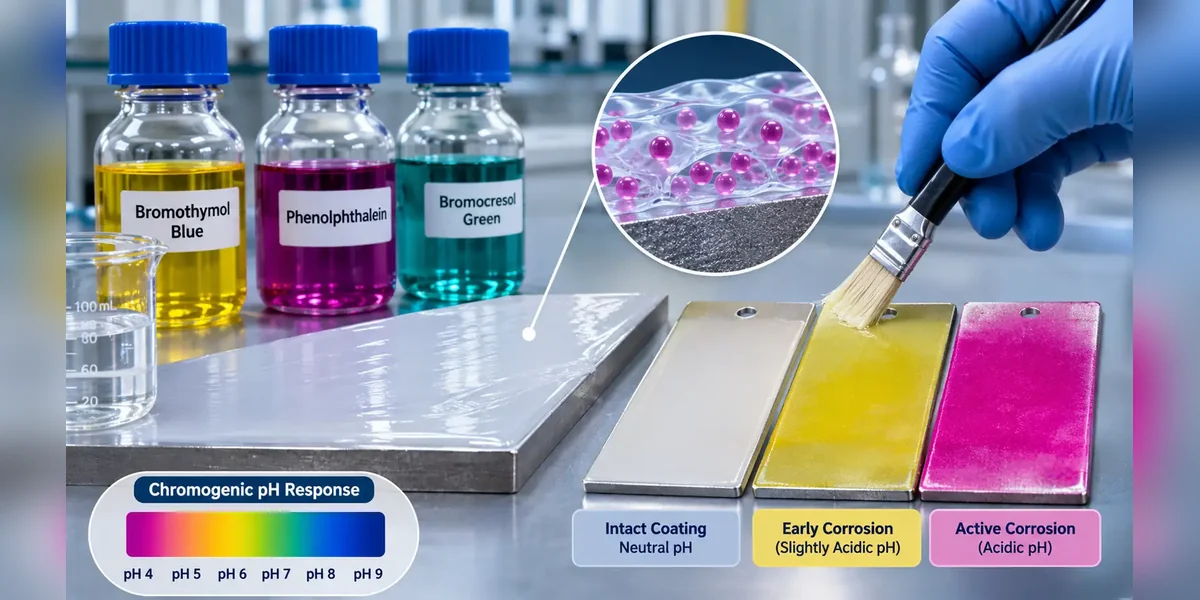
Chromogenic pH Indicators are chemical compounds that produce visible colour changes in response to variations in acidity or alkalinity. This behaviour results from protonation and deprotonation reactions that change the molecular structure and light-absorption properties of the indicator.
Common examples include:
- Phenolphthalein – Changes from colourless to pink or magenta under alkaline conditions, generally around pH 8.2–10.
- Thymol blue – Exhibits two distinct colour transitions across acidic and alkaline pH ranges.
- Bromothymol blue – Changes from yellow under acidic conditions to blue under alkaline conditions.
In protective coatings, these compounds act as chemical sensing agents rather than direct corrosion inhibitors. Their effectiveness depends on their transition range, chemical stability and compatibility with the coating formulation.
How Chromogenic pH Indicators Work in Protective Coatings?
The sensing mechanism is closely connected to the electrochemical reactions involved in corrosion. When moisture and dissolved ions penetrate a damaged coating, anodic and cathodic reactions can develop on the exposed metal. At anodic sites, metal atoms lose electrons and dissolve into the surrounding electrolyte, while metal-ion hydrolysis can contribute to local acidification.
At cathodic sites, oxygen reduction in neutral or alkaline aqueous environments generates hydroxide ions, increasing the local pH. These variations can activate pH-sensitive indicators and produce visible colour changes. For example, phenolphthalein can develop a pink colour in sufficiently alkaline regions associated with cathodic activity.
Incorporating Indicators into Coatings
Indicators can be incorporated directly into coating matrices or protected within specialised carriers. Research has investigated several approaches:
- Silica-based nanocontainers – Help protect indicator molecules and control their exposure.
- Layered double hydroxides – Provide inorganic carrier structures for functional compounds.
- Polymeric microcapsules – Enclose sensing agents to improve compatibility and reduce unwanted interactions.
These approaches can improve indicator stability and reduce premature migration, depending on the carrier design and coating formulation.
Key Benefits of Chromogenic pH-Based Coatings
Chromogenic coatings offer an additional sensing function alongside conventional barrier protection. Their colour responses can help identify local chemical changes that may indicate developing corrosion, particularly around damaged coating areas.
Key benefits include:
- Visual corrosion indication – Provides visible information about local chemical changes.
- Localised monitoring – Helps identify areas requiring closer inspection.
- Maintenance planning – Supports targeted assessment of potentially affected surfaces.
- Formulation flexibility – Can be investigated in polymer-based and sol-gel coating systems.
- Multifunctional potential – Can be combined with corrosion inhibitors and self-healing technologies.
However, colour changes do not automatically confirm corrosion or prevent metal degradation. Further inspection is necessary to establish the actual condition of the substrate.
Major Applications Across Industries
- Infrastructure and construction – Steel bridges, buildings and structural frameworks experience moisture and atmospheric exposure. Responsive coatings could help identify chemical changes beneath damaged protective layers.
- Automotive and transportation – Vehicle bodies and undercarriage components encounter road salts, humidity and other corrosive substances. Chromogenic coatings could provide additional indications of corrosion-related activity around scratches and joints.
- Marine and offshore engineering – Ships, offshore platforms and coastal structures face demanding saltwater exposure. Responsive coatings could support the identification of localised chemical changes requiring further inspection.
- Industrial equipment and manufacturing – Pipelines, storage tanks and chemical-processing equipment require reliable corrosion protection. Smart coatings could provide supplementary information about coating condition in vulnerable locations.
These applications represent potential opportunities rather than universally established commercial uses. Their suitability requires testing under relevant industrial conditions.
The Future of Smart and Responsive Coating Technology
Research into responsive coatings increasingly focuses on combining corrosion detection with additional protective functions. One promising approach involves integrating pH-sensitive indicators with nanocontainers containing corrosion inhibitors. Such systems may provide a visible indication of local chemical changes while releasing protective compounds when appropriate triggers are encountered.
Another development involves combining colourimetric indicators with fluorescent sensing materials. These multifunctional systems could provide additional information about coating damage and corrosion-related conditions. Their practical effectiveness, however, depends on chemical stability, carrier performance and compatibility with the coating matrix.
Further research and industrial validation will be necessary to establish their reliability under real operating conditions.
Conclusion: Towards Smarter and More Durable Surface Protection
Chromogenic pH indicators introduce an important sensing capability into responsive protective coatings. Their ability to produce visible colour changes in response to local acidity or alkalinity variations offers a potential method for identifying chemical conditions associated with corrosion. Combined with conventional barrier systems, they can provide additional information for coating assessment and maintenance planning.
Although challenges involving stability, compatibility and durability remain, advances in encapsulation and multifunctional formulations continue to expand their potential. Their future industrial adoption will depend on demonstrating reliable performance under practical operating conditions.
Explore our range of high-quality pH indicators for laboratory research and industrial applications.