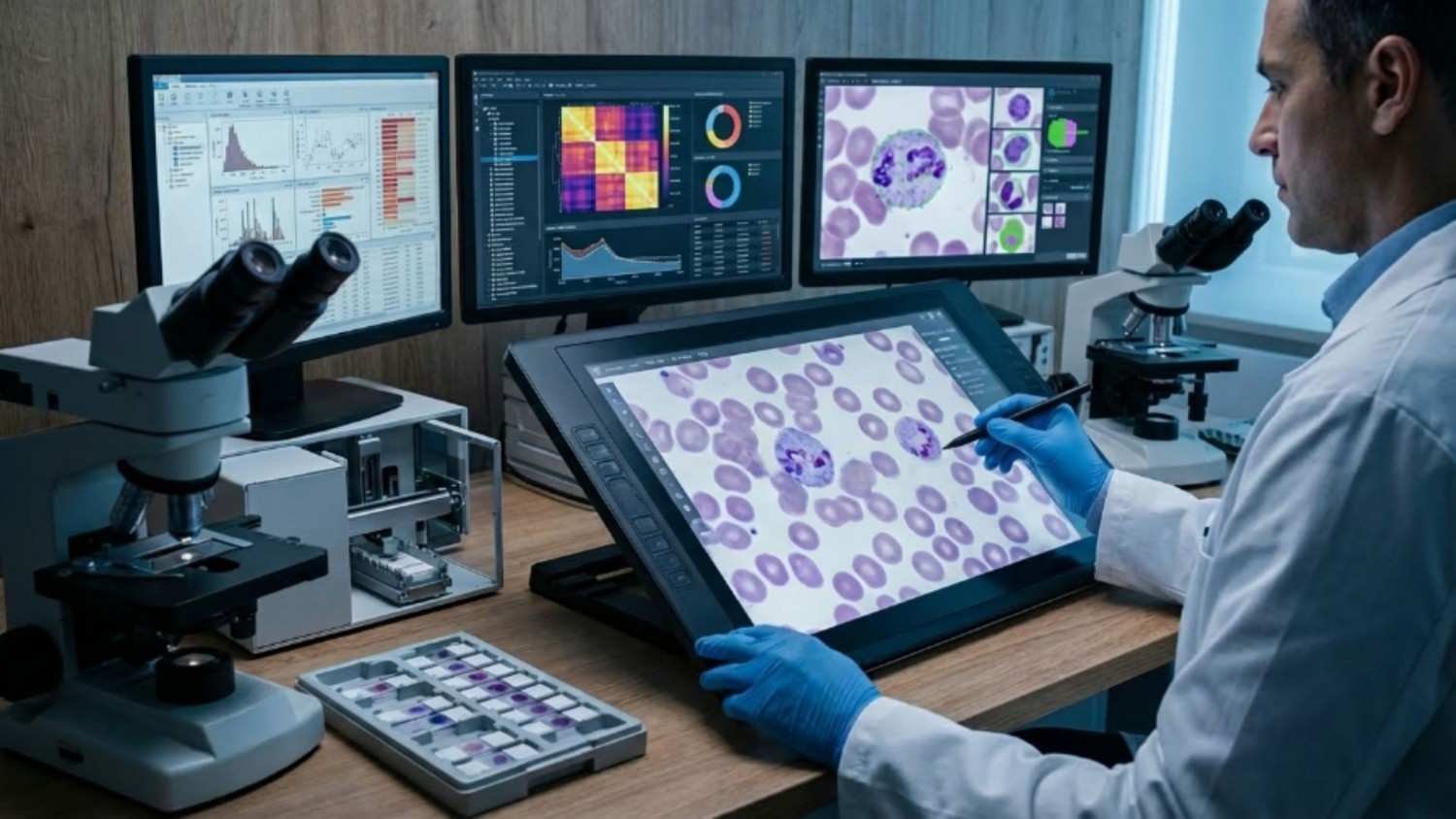
Digital pathology is rapidly transforming the way laboratories analyze and interpret biological samples. With the integration of artificial intelligence (AI) and high-resolution imaging systems, traditional microscopy is evolving into a data-driven, highly precise diagnostic approach.
However, one critical factor remains at the core of accurate digital analysis: staining quality. Among the most widely used staining techniques, Giemsa stain plays a crucial role in hematology, cytogenetics, and infectious disease diagnostics.
As laboratories shift toward AI-powered workflows, the need to optimize Giemsa stains for digital scans has become more important than ever.
What is Giemsa Staining?
Giemsa staining is a classical and widely used technique in laboratory diagnostics that enables clear differentiation of cellular components, particularly in blood smears and bone marrow samples. It plays a crucial role in visualizing blood cell morphology, allowing pathologists to examine structural details with precision. In addition to routine hematological analysis, the Giemsa stain is widely used to detect parasites such as malaria, where accurate identification is critical for timely treatment. It is also valuable in cytogenetics for identifying chromosomal abnormalities, making it an indispensable tool in both diagnostic and research applications.
Key features of Giemsa stain:
- Produces distinct color differentiation between the nucleus and cytoplasm
- Highlights cellular structures with high clarity
- Widely used in diagnostic and research laboratories
The effectiveness of Giemsa staining lies in its ability to provide clear contrast, which is crucial for both human observation and machine-based analysis.
The Rise of Digital Pathology and AI
Digital pathology involves scanning stained slides to create high-resolution digital images that can be analyzed using software and AI algorithms.
Key advantages of digital pathology:
- Faster diagnostic workflows
- Remote access to samples
- Improved collaboration across labs
- Enhanced data storage and retrieval
With AI integration, these systems can:
- Detect abnormalities automatically
- Quantify cell counts with high accuracy
- Identify patterns that may not be visible to the human eye
However, the performance of AI models depends heavily on image quality and staining consistency.
Why Giemsa Stain Optimization is Critical for AI?
Artificial intelligence in digital pathology is fundamentally built on pattern recognition, where algorithms analyze visual data to identify cellular structures and abnormalities. For these systems to function accurately, the input data must be consistent and high in quality. Any inconsistency in Giemsa staining can distort these visual patterns, ultimately leading to unreliable or misleading results.
Poor staining quality can introduce several issues in digital images. Variations in color intensity may cause certain cellular features to appear either exaggerated or faint, while background noise can interfere with the clarity of the image. In some cases, critical structural details may be lost, and the contrast between different cell components can become insufficient for accurate interpretation. These inconsistencies directly affect how AI models interpret the data.
As a result, AI systems may misclassify cells or fail to detect abnormalities correctly, which reduces overall diagnostic accuracy. This often leads to an increased dependency on manual verification, defeating the purpose of automation and slowing down workflows. To ensure that AI-driven pathology delivers reliable outcomes, Giemsa staining must be carefully standardized, reproducible across batches, and optimized specifically for digital imaging environments.
Key Factors in Optimizing Giemsa Stains for AI Scans
Optimizing Giemsa staining for digital pathology involves controlling multiple variables to ensure consistency and clarity.
1. Consistent Chemical Composition
The quality of the stain itself is the foundation of optimization.
- Uniform formulation ensures predictable staining behavior
- High-purity reagents reduce unwanted variations
- Stable chemical properties maintain consistency across batches
2. Standardized Staining Protocols
Even with high-quality stains, inconsistent protocols can lead to variability.
Key considerations include:
- Controlled staining time
- Proper dilution ratios
- Consistent washing procedures
Standardization across laboratories ensures that AI systems receive uniform data inputs.
3. Optimal Color Contrast
AI algorithms depend on clear differentiation between cellular structures.
Ideal staining characteristics:
- Sharp nuclear detail
- Balanced cytoplasmic staining
- Minimal background interference
Optimized Giemsa stains enhance contrast, making it easier for AI systems to detect and classify features accurately.
4. Slide Preparation and Fixation
Sample preparation plays a critical role in staining quality.
- Proper fixation preserves cellular structure
- Uniform smear thickness ensures even staining
- Clean slides reduce artifacts
These factors directly influence the quality of digital images.
5. Compatibility with Digital Scanners
Stains must be optimized for modern imaging systems.
Important factors:
- Color stability under different lighting conditions
- Resistance to fading during scanning
- Consistency across multiple scans
Benefits of Optimized Giemsa Staining for Digital Pathology
When Giemsa staining is properly optimized, laboratories can fully unlock the potential of AI-powered digital pathology systems. High-quality and consistent staining significantly improves diagnostic accuracy by providing clear and well-defined cellular structures, enabling AI algorithms to analyze patterns with greater precision. This clarity also contributes to faster analysis, as high-resolution and noise-free images reduce the time required for processing and interpretation.
In addition, optimized staining helps minimize human error by allowing automated systems to handle repetitive and time-consuming tasks more efficiently. With standardized staining protocols and consistent reagent performance, laboratories can achieve better reproducibility, ensuring that results remain uniform across different locations and time frames. This level of consistency is essential for building trust in AI-driven diagnostics.
The Future of AI-Driven Pathology
The future of pathology lies in the seamless integration of chemistry, imaging, and artificial intelligence. As AI systems become more advanced, the demand for high-quality, standardized staining will continue to grow.
Giemsa staining, when optimized correctly, will remain a cornerstone of this transformation. Its ability to provide detailed cellular visualization makes it indispensable for both traditional and digital workflows.
Conclusion
Optimizing Giemsa stains for AI scans is not just a technical requirement; it is a strategic necessity for modern laboratories. Consistent, high-quality staining ensures that digital pathology systems can deliver accurate and reliable results.
By combining advanced chemical formulations with standardized processes, laboratories can fully leverage the power of AI. With its expertise in biological stains, GSP Chem is playing a vital role in enabling this transformation.
As digital pathology continues to evolve, the importance of optimized staining will only increase, shaping the future of diagnostics worldwide.
Looking to enhance your digital pathology workflows with AI-ready staining solutions?
Partner with GSP Chem for high-quality Giemsa stains designed for precision and consistency.
Contact us today to optimize your lab for the future of diagnostics.